Foundation Repair in Waxahachie
Foundation repair in Waxahachie and Ellis County for homes moving on expansive clay soil. Learn the warning signs, the process, and how to decide.
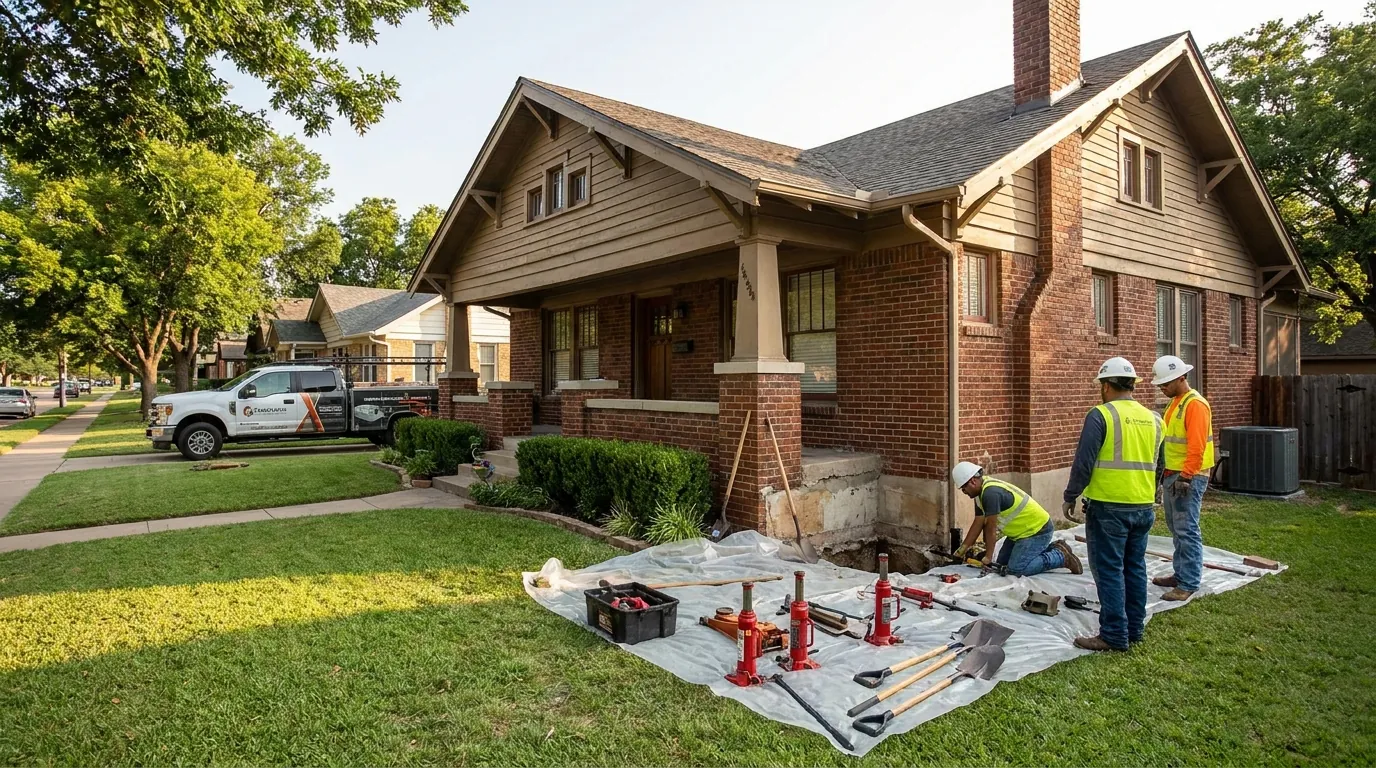
When a Waxahachie home needs foundation repair
Most homes in Waxahachie sit on expansive clay soil, and that single fact explains the majority of foundation problems in Ellis County. When the ground soaks up water during a spring storm it swells; when the summer heat bakes it dry, it shrinks and pulls away from the structure above. That constant wet/dry cycle lifts and drops different parts of a foundation at different rates, and over years the movement shows up inside your house as cracks, sticking doors, and sloping floors.
The goal of foundation repair is not to make a house perfectly level again — soil never cooperates with perfection — but to lift settled areas back toward their original elevation and hold them there so the movement stops damaging the home. Whether your house sits on a concrete slab or a pier and beam frame, the right fix depends on how it was built, how the soil is behaving, and where the movement is concentrated.
If you are not yet sure the problem is your foundation, a good first step is a foundation inspection to measure elevations and identify the cause before any work is scheduled. If drainage is dumping water against one corner of the house, that also needs to be addressed — see drainage correction.
How foundation repair works
Repairing a foundation on clay soil follows a predictable sequence, adjusted for each home.
-
Measure the movement
Elevations are taken across the floor with a level meter so the low and high spots can be mapped. This shows how much a section has dropped and where piers need to go.
-
Choose a support method
Depending on the structure and soil, steel or concrete pressed pilings are driven down to stable load-bearing strata beneath the reactive clay layer.
-
Excavate and place piers
Access holes are dug at the affected points along the perimeter or interior beam lines, and piling segments are pressed into the ground using the weight of the home.
-
Lift and stabilize
Hydraulic jacks raise the settled section as close to its original elevation as the structure safely allows, and the piers are locked off to carry the load.
-
Backfill and verify
Holes are filled, elevations are re-checked, and doors and windows are tested to confirm the movement has been corrected.
Not sure how bad it is?
If you are seeing cracks, sticking doors, or uneven floors, an assessment tells you whether repair is needed now or worth monitoring. Reach out to talk through what you are seeing.
Serving Waxahachie and nearby Ellis County towns.
Frequently asked questions
How do I know if I really need foundation repair?
Warning signs include diagonal cracks above doorways, gaps opening between walls and ceilings, doors that stick or swing on their own, and floors that feel sloped. A measured inspection confirms whether the movement is active and severe enough to warrant repair rather than monitoring.
What drives the cost of foundation repair?
Cost depends mainly on how many piers a home needs, how deep stable soil sits, and how easy the affected areas are to access. Interior piers under a slab cost more than perimeter piers because floor covering has to be opened up. An on-site assessment is the only way to get a real number.
Will repair stop the cracks from coming back?
Stabilizing the foundation stops the structural movement that causes cracks, but managing the soil moisture around the home is what keeps the clay from swinging between extremes. Consistent watering in drought and good drainage in wet months both help the repair last.
How long does the work take?
Many residential repairs are completed in one to three days once work begins, depending on pier count and access. Larger homes or jobs that require interior slab access can take longer.