Slab Foundation Repair in Waxahachie
Slab foundation repair in Waxahachie for concrete slabs cracking and settling on expansive clay. Signs, the piering process, and how to decide.
What happens to slab foundations on clay soil
Most homes built in Waxahachie over the last several decades sit on a concrete slab poured directly on the ground. That works well until the ground itself starts moving — and in Ellis County the ground moves a lot. The expansive clay beneath the slab swells during wet spells and shrinks in the long, hot Texas summers, and because that swelling is never uniform, the slab flexes. Concrete does not bend, so it cracks, and the whole house tilts slightly toward the low corner.
Common signs a slab is in trouble include stair-step cracks in exterior brick, cracks running from the corners of doors and windows, gaps between the crown molding and ceiling, doors and windows that suddenly stick, and floors that feel out of level. A single hairline crack in a garage floor is often nothing; several of these signs together usually means the slab is moving.
Repair lifts the settled part of the slab and holds it in place with pilings driven to stable soil. Because the cause is soil moisture, lasting results also depend on controlling water around the home — pairing repair with drainage correction is common. If you are not certain the slab is the source, start with a foundation inspection.
The slab repair process
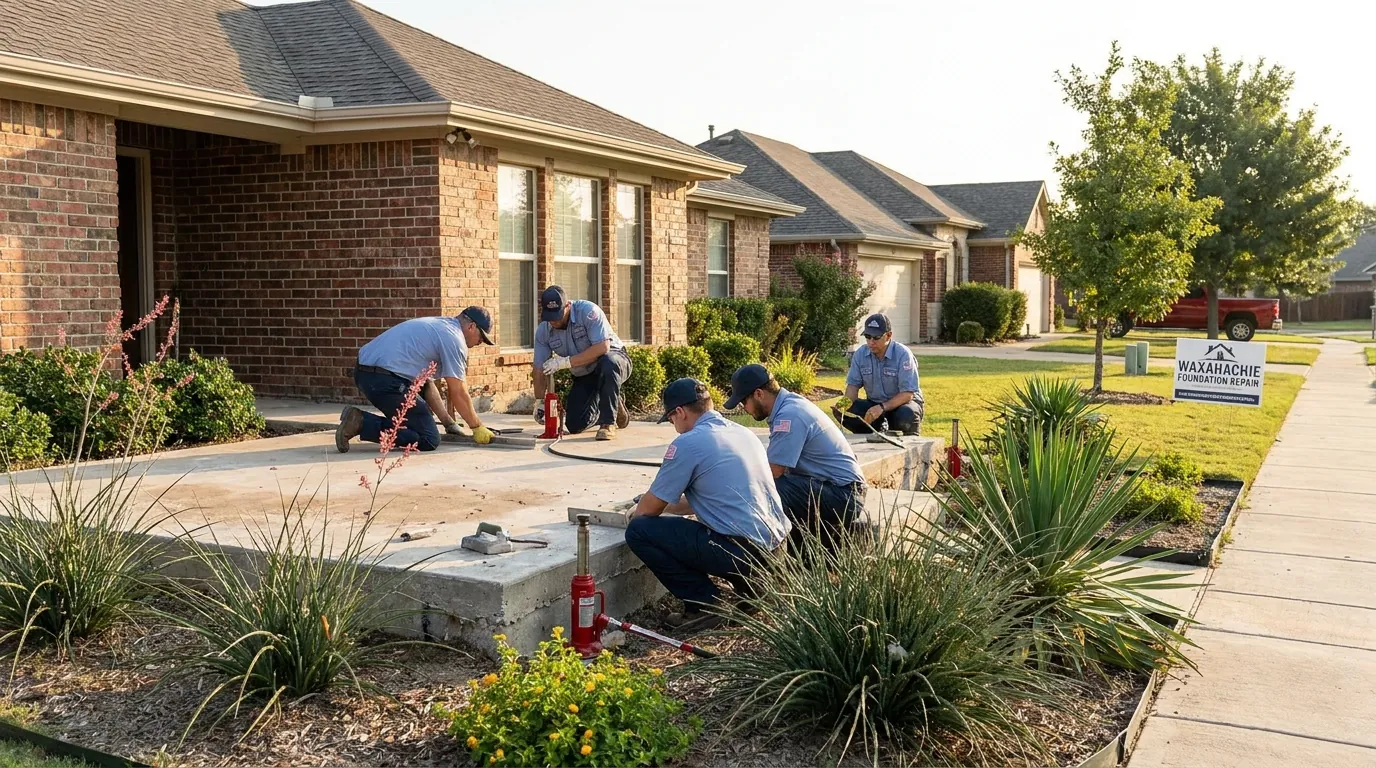
Slab homes are stabilized with pressed pilings placed at the settled areas.
-
Map the slab
Interior and perimeter elevations are measured to locate the low areas and plan pier placement.
-
Excavate access points
Holes are dug at the perimeter, and interior floor covering is opened where an inside pier is required.
-
Press the pilings
Concrete or steel piling segments are hydraulically pressed down through the reactive clay to firmer bearing soil.
-
Lift the slab
Jacks raise the settled slab toward its original elevation while cracks are monitored so nothing is over-lifted.
-
Lock off and restore
Piers are secured to carry the load, holes are backfilled, and openings are patched.
Seeing cracks in a slab home?
Brick cracks, sticking doors, and sloping floors are worth checking before they get worse. Reach out and describe what is happening and where.
Serving Waxahachie and nearby Ellis County towns.
Frequently asked questions
Are cracks in my slab always serious?
Not always. Shrinkage cracks in fresh concrete and thin hairline cracks are common and often cosmetic. Cracks that are widening, offset in height, or paired with sticking doors and sloping floors point to active settlement that should be evaluated.
How deep do the piers have to go?
It depends on where stable soil is below the reactive clay layer, which varies across Ellis County. Piers are pressed until they reach load-bearing strata, so depth is determined during the work rather than guessed beforehand.
Can the slab be fully leveled again?
The goal is to lift the slab as close to its original elevation as it can safely take without cracking finishes further. Practical leveling that stops the damage is the standard, not perfect flatness.
How do I keep it from happening again?
Keeping soil moisture steady around the perimeter is the key on clay soil. Good drainage that carries water away in storms and consistent watering during drought both reduce the swelling and shrinking that moves the slab.